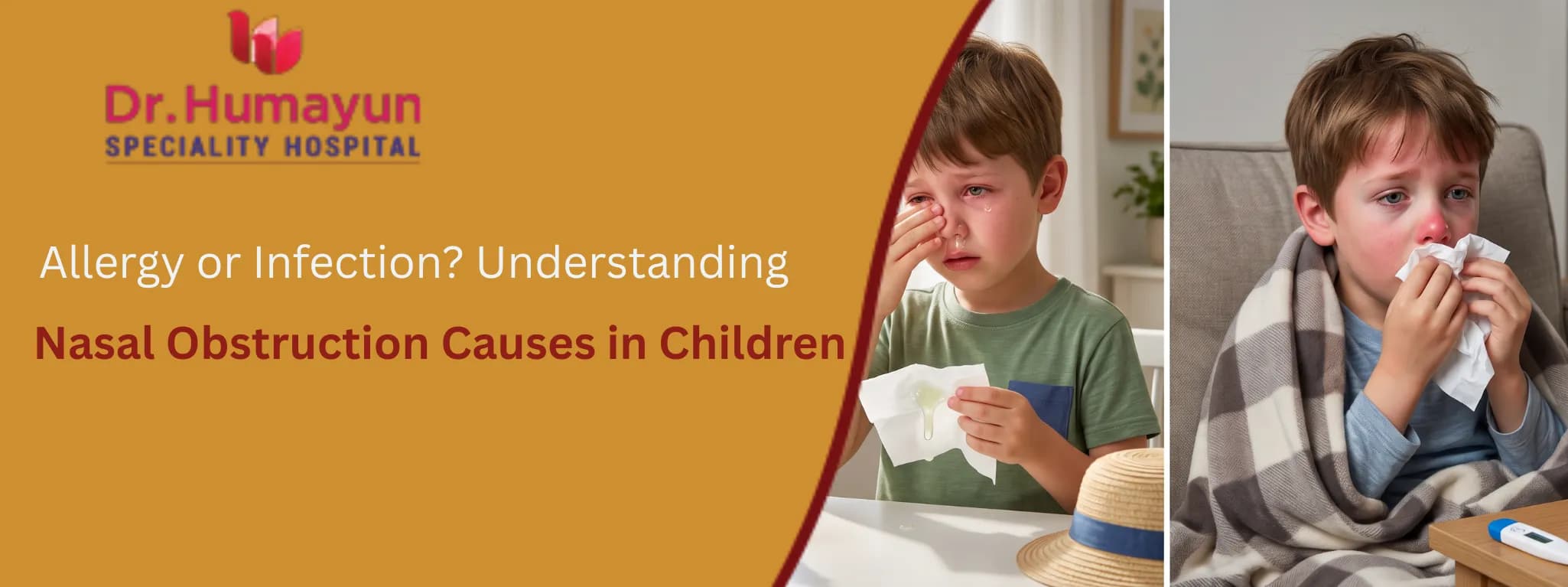

Every parent of a young child knows the sound: the mouth-breathing at night, the snuffly nose, the constant need to wipe. A persistently blocked nose in a child is one of the most common reasons parents seek paediatric and ENT advice in Chennai.
But a blocked nose is not a diagnosis. It is a symptom. The cause behind it determines everything about how it should be managed, whether it will resolve on its own, and whether it needs medical or even surgical treatment.
Understanding the difference between the most common nasal obstruction causes in children, particularly the two causes that overlap most in their symptoms, allergy and infection, gives parents the clarity to seek the right level of care at the right time.
Why Children Get Blocked Noses More Often Than Adults
Children are anatomically and immunologically different from adults in ways that make nasal obstruction significantly more common.
Their nasal passages are narrower relative to their face size, meaning a small amount of swelling or mucus produces a disproportionately large degree of obstruction. Their adenoids, the immune tissue at the back of the nasal cavity, are proportionally larger in childhood and reach peak size between two and seven years of age. Their immune systems are still being educated by a constant stream of new viral and bacterial encounters at school and nursery.
The result is that nasal obstruction in children is not a single, simple problem. It reflects a combination of anatomical vulnerability and immune system activity, shaped by the specific environment the child lives in.
In Chennai specifically, house dust mite allergy, year-round humidity, urban air pollution, and the frequent viral infections of school environments all converge on the nasal passages, making blocked noses a daily reality for a large proportion of the city's children.
The Most Common Nasal Obstruction Causes in Children
Before comparing allergy and infection, it helps to see the full range of causes. In children, the most common cause of nasal obstruction is enlarged adenoid glands. Other important causes include allergic rhinitis, recurrent viral infections, sinusitis, nasal polyps, foreign bodies, and structural issues including deviated septum. Each has a distinct clinical pattern that helps differentiate it from the others.
Enlarged Adenoids
The adenoids are lymph tissue located at the back of the nasal cavity where the nose meets the throat. In children, they are normally large because they play an active role in early immune education. When they become chronically enlarged, they obstruct the posterior nasal airway, producing a permanently blocked nose that does not respond to nasal sprays or decongestants.
Key features of adenoid hypertrophy:
-
Persistent nasal obstruction that is present day and night
-
Mouth breathing, particularly noticeable during sleep
-
Snoring, and in some cases obstructive sleep apnoea
-
A nasal, muffled quality to the voice ("adenoidal voice")
-
Recurrent ear infections, because enlarged adenoids obstruct the Eustachian tube opening
-
No itchy nose, no sneezing, no watery eyes
Enlarged adenoids are structural rather than inflammatory in origin. They do not respond to antihistamines or nasal sprays. Significant adenoid hypertrophy causing sleep-disordered breathing, recurrent ear infections, or persistent nasal obstruction is managed surgically with adenoidectomy.
Allergic Rhinitis
Allergic rhinitis is one of the most frequently diagnosed nasal obstruction causes in children in India. The chronic allergic inflammation of nasal mucosa is responsible for nasal discharge, itching, sneezing, and blockage or severe congestion, but also for recurrent infections, which explains why allergic children often seem to have a cold that never fully clears.
In Chennai, house dust mite allergy drives a large proportion of perennial allergic rhinitis cases, because the warm, humid climate is ideal for dust mite proliferation year-round. Unlike pollen-driven seasonal allergy, house dust mite allergy produces symptoms throughout the year without a predictable seasonal peak.
Features that suggest allergic rhinitis rather than infection:
-
Nasal obstruction that worsens in certain environments (the bedroom, dusty rooms) and improves in others
-
Sneezing in runs of multiple sneezes, particularly in the morning
-
Intense itching inside the nose
-
Itchy, watery eyes (allergic conjunctivitis often accompanies allergic rhinitis)
-
Clear, watery nasal discharge rather than coloured discharge
-
A personal or family history of asthma, eczema, or other allergies
-
Symptoms that have been present for more than two weeks without fever
The "allergic salute," where a child rubs their nose upward repeatedly with the palm of their hand, and a transverse crease across the nose from chronic rubbing, are classic physical signs of long-standing allergic rhinitis.
Viral Upper Respiratory Infections
Viral infections are the most common cause of acute nasal obstruction in children. The common cold, influenza, and RSV all produce nasal mucosal swelling, increased mucus production, and the familiar blocked nose of a childhood respiratory illness.
Features that suggest a viral infection rather than allergy:
-
Sudden onset, often after exposure to a sick contact or after returning from school
-
Fever, muscle aches, or sore throat alongside the blocked nose
-
Coloured discharge (yellow or green) developing after the first two to three days
-
Accompanied by cough in most cases
-
Resolves within seven to ten days
Viral nasal obstruction is self-limiting and resolves without antibiotic treatment. A cold that follows the typical pattern of worsening over three to four days and improving over the following week in a child who is otherwise well does not require medical treatment or antibiotics.
The diagnostic challenge arises when a viral illness does not resolve within the expected window, or when the symptoms seem to cycle through episode after episode without a clear recovery period between them. At this point, distinguishing between recurrent viral infections, allergic rhinitis, and chronic sinusitis becomes the clinical priority.
Bacterial Sinusitis
Sinusitis in children typically follows a viral upper respiratory infection that does not resolve as expected. When viral nasal inflammation persists beyond ten days without improvement, or when symptoms worsen after an initial period of improvement (the "double sickening" pattern), bacterial sinusitis should be considered.
Features suggesting bacterial sinusitis rather than a lingering cold:
-
Nasal symptoms lasting more than ten days without improvement
-
Facial pain or pressure, particularly over the cheeks or forehead
-
Fever alongside persistent nasal discharge
-
Headache that is worse when bending forward
-
Thick, coloured discharge that does not improve with time
Bacterial sinusitis requires antibiotic treatment. Chronic sinusitis, where symptoms persist for twelve weeks or more, requires ENT assessment and in some cases functional endoscopic sinus surgery (FESS).


Foreign Body in the Nose
This is the nasal obstruction cause that parents most frequently miss and that carries the highest risk if not identified promptly. Young children, typically toddlers, insert small objects into their nasal passages: beads, food, foam pieces, small toy parts.
The single most important clinical pointer: unilateral nasal obstruction with foul-smelling discharge in a child under four years of age is a foreign body until proven otherwise.
A foreign body in the nose does not produce itching, sneezing, or fever. It produces a blocked nose on one side only, often with a foul-smelling or blood-tinged discharge. The history of what the child might have inserted may not be available because the child was unsupervised or cannot communicate clearly.
Do not attempt to remove a nasal foreign body at home. ENT specialist assessment and professional removal under appropriate conditions is required to avoid pushing the object further in or into the airway.
Nasal Polyps and Structural Causes
Nasal polyps in children are soft, benign growths in the nasal passages and sinuses. They produce a persistent, bilateral blocked nose that does not respond to decongestants and are associated with allergic rhinitis, chronic sinusitis, and in some children, cystic fibrosis.
Structural causes including a deviated nasal septum produce unilateral or asymmetric obstruction that is mechanical rather than inflammatory, does not fluctuate with seasons or exposures, and does not respond to medications.
Allergy vs Infection at a Glance
Parents often find it helpful to compare the two most commonly confused causes side by side.
| Feature | Allergic Rhinitis | Viral Infection |
|---|---|---|
| Onset | Gradual, related to exposure | Sudden |
| Duration | Weeks to months | 7 to 10 days |
| Discharge | Clear, watery | Clear initially, then coloured |
| Sneezing | Frequent, in runs | Present but not dominant |
| Itchy nose/eyes | Yes | Rarely |
| Fever | No | Often |
| Cough | Possible (postnasal drip) | Common |
| Improves with antihistamine | Yes | No |
| Seasonal pattern | Possible (or year-round) | Random onset |
This comparison is a guide for parents, not a diagnostic tool. When symptoms overlap or persist beyond expected timelines, clinical assessment and where indicated allergy testing or nasal endoscopy is needed.
When Is Non-Surgical Treatment Enough?
The majority of nasal obstruction causes in children respond to medical management without any surgical intervention.
Conditions managed successfully without surgery:
-
Allergic rhinitis: treated with intranasal corticosteroid sprays (mometasone from age three, fluticasone from age four), antihistamines, nasal saline rinses, and allergen avoidance. House dust mite allergy in Chennai benefits from mattress and pillow covers, regular washing of bedding, and HEPA air filtration.
-
Viral upper respiratory infections: self-limiting, managed with saline nasal drops, adequate hydration, and paracetamol for comfort
-
Mild acute sinusitis: watchful waiting for ten days before antibiotics, with saline irrigation
-
Bacterial sinusitis: antibiotic treatment with amoxicillin-clavulanate as first-line
-
Allergic rhinitis with chronic nasal congestion: intranasal corticosteroids are highly effective and are the most evidence-supported treatment for perennial allergic rhinitis in children
When Surgery Is Recommended
Surgery becomes the appropriate recommendation when a structural or anatomical cause is producing significant symptoms that do not respond to medical management.
Indications for surgery in paediatric nasal obstruction:
-
Adenoid hypertrophy causing obstructive sleep apnoea, recurrent ear infections, or persistent nasal obstruction unresponsive to medical treatment: adenoidectomy is a safe, well-established procedure with high parental and patient satisfaction
-
Nasal polyps unresponsive to corticosteroid therapy: endoscopic polypectomy
-
Chronic sinusitis with blocked sinus drainage unresponsive to prolonged medical management: functional endoscopic sinus surgery (FESS)
-
Significantly deviated nasal septum causing severe unilateral obstruction: septoplasty, typically deferred until after nasal growth is largely complete (usually after age 16 to 18)
-
Foreign body: professional removal under ENT specialist care
-
Choanal atresia or other congenital structural abnormalities: surgical correction based on severity
The decision between medical and surgical management should follow thorough ENT assessment. No surgical intervention for nasal obstruction should be recommended without first establishing the specific cause and demonstrating that appropriate medical management has been tried and found insufficient.
Assessment at Humayun Hospital, T Nagar
At Humayun Hospital, T Nagar, Chennai, our ENT and paediatric team provides structured, evidence-based assessment for nasal obstruction causes in children at every age and every severity level. We offer:
-
Clinical history and examination including nasal endoscopy
-
Allergy testing (skin prick testing and specific IgE) for children where allergic rhinitis is suspected
-
CT scan of the paranasal sinuses for children with chronic or complicated sinusitis
-
Audiometry and tympanometry for children where adenoid hypertrophy may be affecting hearing and ear health
-
Intranasal corticosteroid and antihistamine management for allergic rhinitis
-
Adenoidectomy, polypectomy, and FESS for children where surgical management is indicated
-
Clear, parent-centred explanation of findings and management options at every stage
Whether your child has been mouth-breathing for months, has a blocked nose that worsens every time they go to bed, or has one-sided discharge that does not smell right, a structured assessment gives the correct diagnosis and the most appropriate treatment plan.
Chat with our medical care assistant for quick guidance and support.