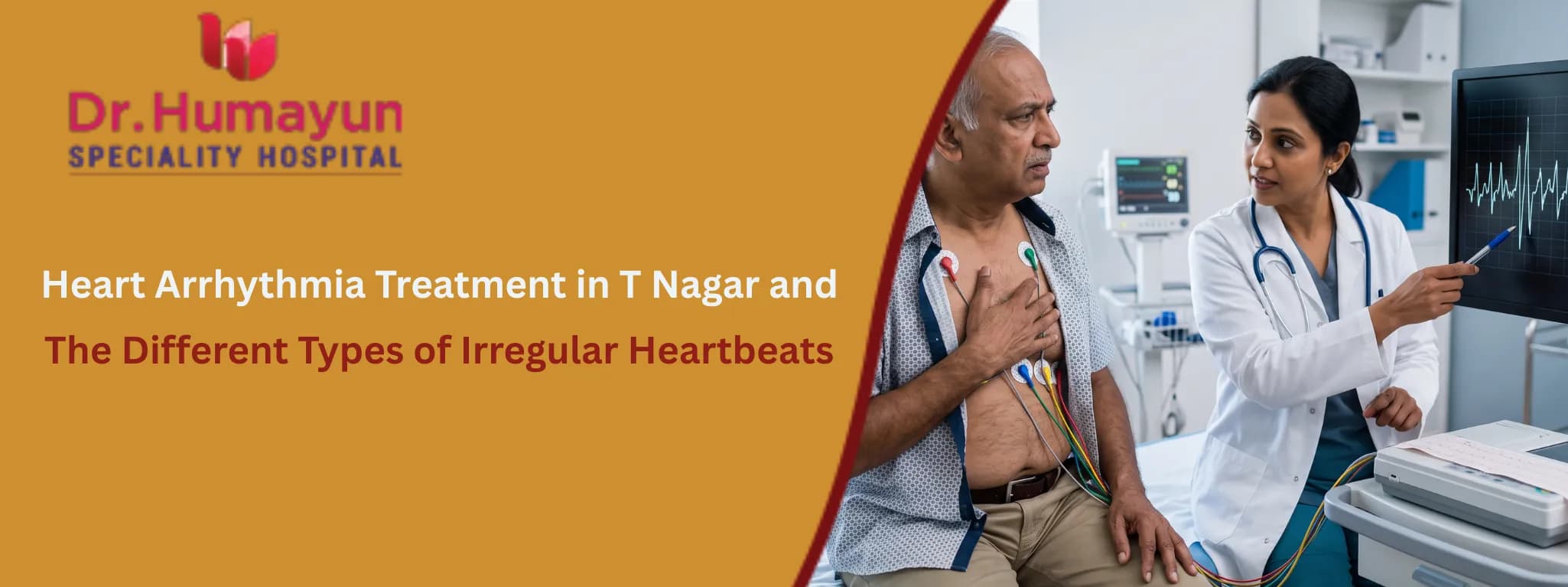

The heart is supposed to beat with rhythmic reliability: 60 to 100 times per minute at rest, rising predictably with activity, falling again with rest. When it does not, the experience can range from barely noticeable to terrifying.
A fluttering sensation in the chest. A heartbeat that seems to skip or pause. A sudden racing pulse that begins without warning and stops just as abruptly. A heart that pounds during minimal exertion or at complete rest. These are the experiences that bring patients to seek heart arrhythmia treatment in T Nagar and across Chennai, sometimes in acute distress and sometimes years after first noticing the problem.
Understanding what types of arrhythmia exist, what symptoms should prompt same-day assessment versus routine investigation, and what the full range of treatment options includes helps patients navigate this territory with clarity rather than anxiety.
What Is a Heart Arrhythmia?
An arrhythmia is any abnormality in the rate, rhythm, or electrical conduction sequence of the heartbeat. It encompasses conditions where the heart beats too fast (tachycardia), too slowly (bradycardia), or irregularly, as well as conditions where the electrical signal follows an abnormal pathway through the heart even when the rate appears normal.
The heart's electrical system works through a precisely coordinated pathway: the sinoatrial (SA) node fires spontaneously, sending an impulse across the atria, through the atrioventricular (AV) node, down the bundle of His, through the left and right bundle branches, and into the Purkinje fibres that activate the ventricular muscle. Any disruption to this pathway, whether from structural damage, inflammation, abnormal tissue, or electrical instability, produces an arrhythmia.
Most arrhythmias originate in one of two locations:
-
Supraventricular arrhythmias: Arising in the atria or AV node, above the ventricles. These are generally less immediately life-threatening but can cause significant symptoms and long-term complications if untreated.
-
Ventricular arrhythmias: Arising in the ventricles themselves. These range from benign (isolated ventricular ectopics in a structurally normal heart) to immediately life-threatening (ventricular fibrillation, which is cardiac arrest).
Types of Heart Arrhythmia and Their Characteristic Features
Atrial Fibrillation (AFib)
Atrial fibrillation is the most common sustained cardiac arrhythmia, affecting approximately 37 million people worldwide. The atria fire chaotically at 300 to 600 impulses per minute, producing an irregularly irregular ventricular rhythm.
Characteristic features:
-
Irregularly irregular pulse: no predictable pattern to the beats
-
Palpitations: many patients describe a fluttering, quivering, or racing sensation
-
Breathlessness, fatigue, and reduced exercise tolerance
-
Risk of stroke from atrial clot formation (five times higher than the general population)
-
May be entirely asymptomatic and discovered incidentally on ECG
AFib is classified as paroxysmal (self-terminating), persistent (lasting more than seven days), long-standing persistent (more than 12 months), or permanent. Treatment includes anticoagulation for stroke prevention, rate control or rhythm control with medication, and increasingly catheter ablation as a first-line rhythm control strategy.
Atrial Flutter
Atrial flutter is a rapid but organised atrial rhythm, typically at 250 to 350 beats per minute, where the atrium circulates an electrical impulse in a stable loop (re-entry circuit). The ventricles typically respond at half the atrial rate (2:1 block), producing a heart rate of approximately 150 beats per minute.
Characteristic features:
-
Regular or regularly irregular rapid pulse
-
Symptoms similar to AFib: palpitations, breathlessness, fatigue
-
Saw-tooth pattern on ECG
-
Strongly associated with atrial fibrillation: most patients with atrial flutter eventually develop AFib
Atrial flutter is highly amenable to catheter ablation. Ablation of the cavotricuspid isthmus (the circuit pathway) produces cure rates above 90%, making it the treatment of choice in most centres for symptomatic typical atrial flutter.
Supraventricular Tachycardia (SVT)
SVT is a group of arrhythmias originating above the ventricles that produce sudden episodes of rapid heart rate, typically 150 to 250 beats per minute. The most common types are:
AVNRT (atrioventricular nodal re-entry tachycardia): The most common type of SVT. An electrical loop circulates within the AV node. Produces sudden-onset, sudden-offset rapid regular palpitations often with neck pulsation, dizziness, and chest discomfort.
AVRT (atrioventricular re-entry tachycardia): Involves an accessory pathway (an extra electrical connection between the atria and ventricles bypassing the AV node). Wolff-Parkinson-White syndrome is the most clinically significant form, where the accessory pathway can conduct very rapidly during AFib, potentially triggering ventricular fibrillation.
SVT is characteristically described by patients as sudden-onset racing heartbeat that stops abruptly, sometimes terminated by bearing down or drinking cold water (vagal manoeuvres). It is not immediately life-threatening in most cases but is extremely symptomatic and disruptive to quality of life. Catheter ablation cures most SVT types with success rates above 95%.
Ventricular Premature Contractions (VPCs/PVCs)
Ventricular premature contractions are extra beats arising in the ventricles, occurring earlier than expected. They are extremely common, present in most adults to some degree, and in the context of a structurally normal heart are generally benign.
Characteristic features:
-
A sensation of a skipped beat, a thump in the chest, or a pause followed by a strong beat
-
Often noticed at rest or at low heart rates when sinus beats are slower
-
Can occur in isolation or in runs (bigeminy, trigeminy)
-
Worsened by caffeine, stress, and poor sleep
Investigation is warranted when VPCs are very frequent (above 10,000 per 24 hours), occur during exercise rather than resolving with it, or when there is any associated structural heart disease. In structurally normal hearts, reassurance and lifestyle modification are the primary management.
Ventricular Tachycardia (VT)
Ventricular tachycardia is a rapid ventricular rhythm at above 100 beats per minute arising from within the ventricular myocardium. It is classified by duration (non-sustained versus sustained) and by haemodynamic impact (tolerated versus causing haemodynamic compromise).
VT ranges from short runs of non-sustained VT in structurally normal hearts (often benign) to sustained VT in the context of prior myocardial infarction or cardiomyopathy (potentially life-threatening).
Characteristic features of clinically significant VT:
-
Rapid, sustained palpitations with dizziness, near-fainting, or loss of consciousness
-
Occurs during or after exertion in some forms
-
Wide complex tachycardia on ECG
-
Associated with structural heart disease in the majority of clinically important cases
VT in the context of structural heart disease is treated with antiarrhythmic drugs, ICD implantation for sudden cardiac death prevention, catheter ablation for VT storm or recurrent ICD shocks, and underlying heart disease management.
Ventricular Fibrillation (VF)
Ventricular fibrillation is a completely chaotic ventricular rhythm with no organised contraction, producing no cardiac output. It is the most common immediate cause of sudden cardiac death. VF is a cardiac arrest: the patient collapses, loses consciousness, and stops breathing.
VF requires immediate defibrillation. Survival depends critically on how quickly CPR and defibrillation are initiated. Every minute without defibrillation reduces survival by approximately 10%.
Patients who survive VF require evaluation of the underlying cause and, in most cases, ICD implantation for secondary prevention of sudden cardiac death.
Bradyarrhythmias: Sinus Node Dysfunction and Heart Block
Not all arrhythmias are too fast. Bradyarrhythmias are arrhythmias where the heart beats too slowly or pauses, either because the SA node is not firing reliably (sick sinus syndrome) or because the electrical signal is blocked between the atria and ventricles (heart block).
Characteristic features:
-
Fatigue, reduced exercise tolerance, and lightheadedness that patients often attribute to ageing or deconditioning
-
Syncope (fainting) or pre-syncope: the most alarming presentation
-
Very slow resting heart rate below 40 to 50 beats per minute on ECG or Holter monitoring
-
Pauses between beats detected on Holter or event monitor
Complete heart block and symptomatic sick sinus syndrome are treated with permanent pacemaker implantation, which is the definitive and highly effective treatment for these conditions.


How Is an Arrhythmia Diagnosed?
Accurate diagnosis is the foundational step in heart arrhythmia treatment in Chennai. The same symptom of palpitations can arise from a harmless ectopic beat, an SVT, atrial fibrillation, or a ventricular arrhythmia. Treatment is completely different for each.
ECG (Electrocardiogram)
The resting 12-lead ECG is the first investigation for any arrhythmia. It captures the heart's electrical activity at the time of recording and can diagnose an arrhythmia that is present at that moment, as well as identify structural features including bundle branch blocks, pre-excitation (accessory pathways as in WPW syndrome), and prior myocardial infarction changes that indicate substrate for arrhythmia.
The limitation is that many arrhythmias are paroxysmal: they occur intermittently and may not be present during the few seconds of an ECG recording.
Holter Monitor (24 to 72-Hour ECG)
A Holter monitor is a portable ECG device worn continuously for 24 to 72 hours, recording every heartbeat during normal daily activity. It captures arrhythmias that occur during the monitoring period and provides data on heart rate variability, ectopic burden, and any correlation between symptoms and rhythm changes. For frequent palpitations occurring most days, a 24-hour Holter is often sufficient for diagnosis.
Extended Cardiac Monitoring
For infrequent palpitations that occur less than weekly, a 24 to 72-hour Holter may miss the arrhythmia entirely.
Extended monitoring options include:
-
External event monitors worn for two to four weeks
-
Implantable loop recorders (ILR): a small device inserted under the skin that records continuously for up to three years, capturing infrequent arrhythmias including those causing unexplained syncope
Electrophysiology Study (EPS)
An electrophysiology study is an invasive catheter-based assessment performed in a cardiac catheterisation laboratory. Catheters are advanced through the femoral vein to the heart, and the electrical system is mapped and tested by delivering controlled electrical impulses to induce and identify arrhythmias. EPS is used to diagnose the specific circuit of SVT or VT, to assess accessory pathway properties in WPW syndrome, and to guide catheter ablation which is typically performed in the same procedure.
Echocardiogram
Echocardiography assesses cardiac structure and function, identifying structural heart disease that creates substrate for arrhythmia. Reduced ejection fraction, wall motion abnormalities, and valve disease are all identified by echocardiogram and inform both the arrhythmia mechanism and the risk stratification for serious events.
Heart Arrhythmia Treatment Options
Heart arrhythmia treatment depends on the type and severity of the specific rhythm disorder. With heart arrhythmia treatment, many people can live full, normal lives.
Medications
-
Antiarrhythmic drugs (AADs): Suppress arrhythmia initiation or maintain normal sinus rhythm. Common agents include flecainide and propafenone for SVT and AFib in structurally normal hearts, sotalol for various tachyarrhythmias, and amiodarone for both supraventricular and ventricular arrhythmias in patients with structural heart disease. Dronedarone and others complete the pharmacological armamentarium.
-
Rate control medications: Beta-blockers (metoprolol, bisoprolol) and calcium channel blockers (diltiazem, verapamil) slow AV node conduction, controlling the ventricular rate in AFib and flutter without restoring sinus rhythm.
-
Anticoagulants: Direct oral anticoagulants (DOACs: apixaban, rivaroxaban, dabigatran, edoxaban) and warfarin reduce stroke risk in AFib and are prescribed based on the individual's CHA2DS2-VASc stroke risk score. This component of heart arrhythmia treatment in T Nagar is not optional for most AFib patients: it is the most life-saving element.
Cardioversion
Electrical cardioversion delivers a controlled electric shock through adhesive electrodes on the chest, synchronised to the QRS complex, that simultaneously depolarises all cardiac cells and allows the SA node to re-establish normal sinus rhythm. It is used for AFib, atrial flutter, and some forms of VT that are haemodynamically stable.
Chemical cardioversion uses intravenous or oral antiarrhythmic drugs to restore sinus rhythm without an electrical shock. Flecainide and propafenone are the most commonly used agents for chemical cardioversion of AFib.
Catheter Ablation
Catheter ablation is a procedure in which catheters are passed through the veins to the heart, and energy is delivered to destroy the small area of heart tissue generating or sustaining the arrhythmia. It is the cornerstone of curative treatment for many arrhythmias.
Ablation energy types:
-
Radiofrequency ablation (RFA): Uses heat to create scar tissue. The traditional approach with over two decades of validated outcomes data.
-
Cryoablation: Uses extreme cold (cryogenic freezing) to create scar tissue. Particularly used for pulmonary vein isolation in AFib (cryoballoon ablation).
-
Pulsed field ablation (PFA): The most significant innovation in ablation technology in 2024. Three PFA systems received FDA approval in 2024 (Farapulse in January, Varipulse and the Affera system subsequently). PFA uses ultra-short electrical pulses that selectively destroy cardiac tissue while sparing the oesophagus and phrenic nerve, which are vulnerable to thermal injury with heat or cold-based approaches. PFA dominated the electrophysiology landscape in 2024 according to the top heart rhythm news review.
Ablation success rates by arrhythmia type:
-
Typical atrial flutter: above 90% success with a single procedure
-
AVNRT (common SVT): above 95% success
-
AVRT and accessory pathways: above 95% success
-
Paroxysmal AFib (pulmonary vein isolation): 65 to 85% single-procedure success at 12 months
-
Persistent AFib: lower single-procedure success rates, often requiring repeat procedures
-
Ventricular tachycardia in structural heart disease: variable, typically 70 to 80% acute success
Implantable Devices
-
Implantable cardioverter-defibrillator (ICD): Continuously monitors heart rhythm and delivers an internal shock when VT or VF is detected, preventing sudden cardiac death. Indicated for survivors of cardiac arrest, patients with significantly reduced ejection fraction at high risk of arrhythmic death, and those with specific inherited arrhythmia syndromes.
-
Pacemaker: Treats bradyarrhythmias including sick sinus syndrome and heart block by delivering electrical impulses to maintain an adequate heart rate.
-
Cardiac resynchronisation therapy (CRT): A specialised pacemaker that coordinates left and right ventricular contraction in patients with heart failure and electrical dyssynchrony, improving cardiac output.
Lifestyle and Trigger Modification
For many arrhythmias, particularly isolated ectopics, SVT episodes, and paroxysmal AFib, lifestyle modification directly reduces arrhythmia frequency and burden:
-
Reducing or eliminating caffeine
-
Limiting or stopping alcohol (one of the strongest AFib triggers)
-
Regular moderate-intensity aerobic exercise (which paradoxically both provokes and reduces long-term AFib risk depending on intensity)
-
Adequate and consistent sleep
-
Stress management and treatment of anxiety
-
Weight management: obesity is a significant and well-evidenced driver of AFib recurrence and ablation failure
-
Treatment of sleep apnoea: strongly associated with AFib and shown to improve ablation outcomes when treated before the procedure
Symptoms That Need Same-Day Assessment
Not every abnormal heartbeat requires immediate attention. Many ectopic beats and brief palpitations are benign and require investigation rather than emergency care. However, specific features indicate that same-day cardiac assessment is needed.
Seek same-day assessment for:
-
Palpitations with dizziness, lightheadedness, or near-fainting
-
Palpitations with chest pain or pressure
-
Palpitations with significant breathlessness
-
A very slow or very rapid pulse that persists beyond a few minutes
-
Palpitations in a patient with known structural heart disease or reduced ejection fraction
-
An episode of actual loss of consciousness following palpitations
Seek emergency care immediately for:
-
Collapse or loss of consciousness
-
A pulse that is absent, barely palpable, or extremely irregular alongside feeling very unwell
-
Chest pain alongside palpitations in a patient with cardiac risk factors
-
Sustained rapid regular palpitations not terminating despite vagal manoeuvres in a patient with known WPW syndrome
Heart Arrhythmia Treatment in Chennai at Humayun Hospital, T Nagar
At Humayun Hospital, T Nagar, Chennai, our cardiology and internal medicine team provides comprehensive heart arrhythmia treatment in Chennai, from the initial diagnostic assessment through to medication management and appropriate referral for electrophysiology procedures and device implantation.
We offer:
-
Resting 12-lead ECG with expert interpretation for arrhythmia diagnosis
-
24 to 72-hour Holter monitoring for paroxysmal arrhythmia capture
-
Echocardiography for structural heart disease assessment underlying arrhythmia
-
Anticoagulation initiation and management for AFib using CHA2DS2-VASc risk stratification
-
Rate and rhythm control medication management for AFib, atrial flutter, SVT, and other arrhythmias
-
Electrical cardioversion planning and coordination for appropriate patients
-
Electrophysiology referral for catheter ablation of SVT, atrial flutter, AFib, and ventricular arrhythmias
-
ICD and pacemaker assessment and referral
-
Lifestyle modification guidance specific to the patient's arrhythmia type and trigger profile
-
Clear, ongoing follow-up to monitor treatment response and adjust management as the clinical picture evolves
For patients in T Nagar and across Chennai who are experiencing irregular heartbeats, unexplained palpitations, or who have received an arrhythmia diagnosis and want specialist guidance on the best treatment path, our cardiology team provides the clinical clarity that this complex area of heart medicine requires.
Chat with our medical assistant for quick guidance and support.